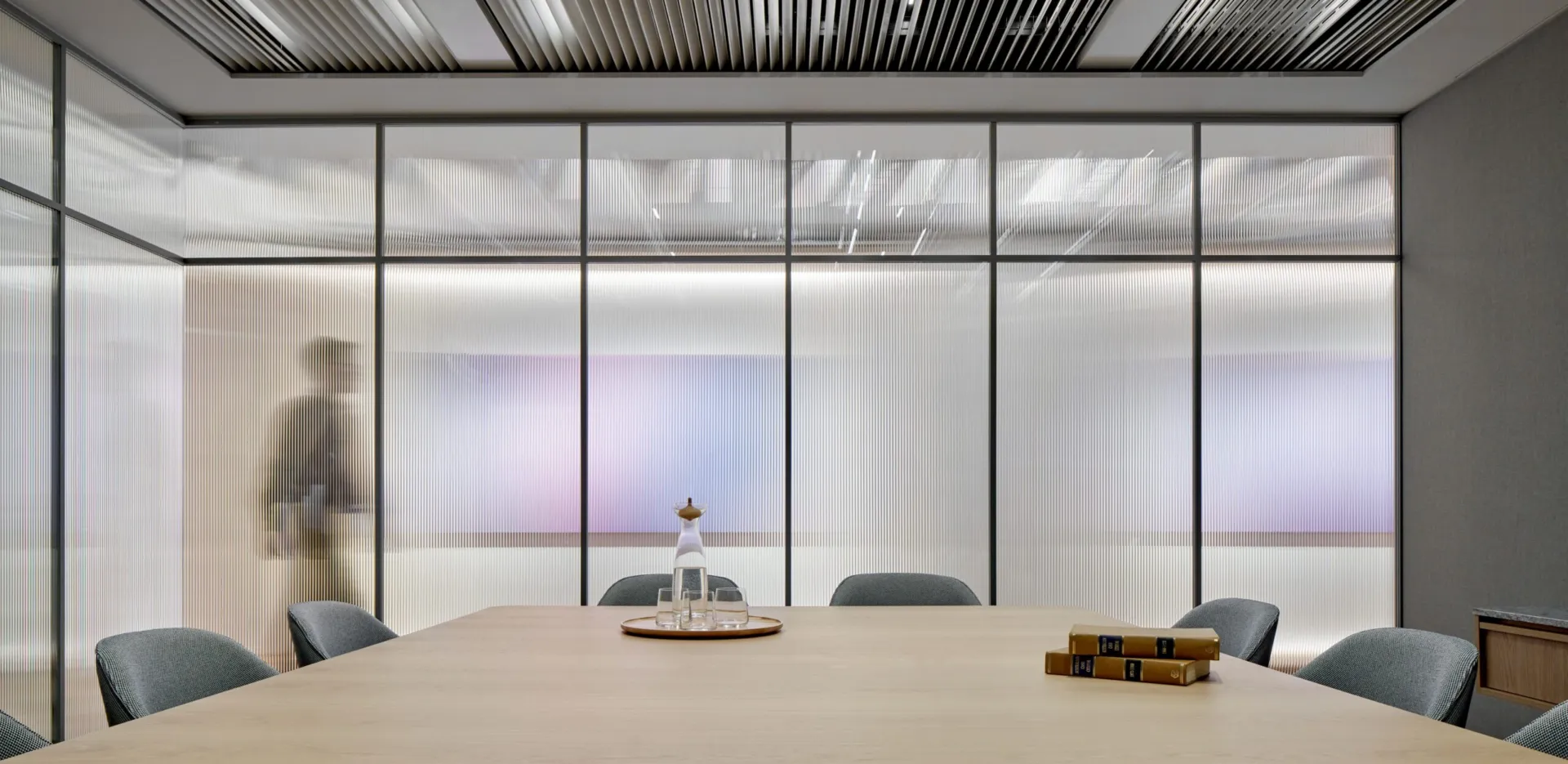
Specifying glass partitions? Your guide to understanding sound
To understand how glass partitions function, it is essential to start with the decibel scale. This provides the necessary context for choosing the right specification for your workspace.
The scale is logarithmic rather than linear. To put this into perspective: near-total silence is recorded at 0dB. A sound ten times more powerful is 10dB, one hundred times more powerful is 20dB, and a sound one thousand times more powerful is 30dB.
To help visualise these levels, here are some common sounds and their typical decibel ratings:
• Near-total silence: 0dB
• A whisper: 15dB
• Normal conversation: 60dB
• A lawnmower: 90dB
• A car horn: 110dB
• A jet engine: 120dB
• A gunshot: 140dB
Defining Acoustic Performance
Partitions are acoustically rated based on their performance during rigorous laboratory tests. These tests generate an index that allows us to compare different partition systems and determine their suitability for specific office applications.
The industry follows ISO 140 for acoustic test procedures and ISO 717 for the rating procedure itself. These standards allow building elements to be classified using a single figure: the Weighted Sound Reduction Index (Rw). This figure serves as a universal benchmark for ease of comparison and selection.
During testing, a partition is constructed within an aperture between two isolated chambers. A sound source in one chamber produces a wide spectrum (from 100 to 4000 Hz). The sound received in the second chamber is then plotted on a curve showing frequency against sound reduction. The value at 500 Hz is deemed the ‘weighted rating’ or ‘Rw’.
Understanding Sound On-Site
While laboratory tests are conducted under optimised conditions, real-world environments are far more complex. Most buildings contain various acoustic pathways—known as flanking transmissions—which can significantly reduce the effective sound insulation.
Typical sources of sound leakage include:
- Trunking passing through walls, floors, and ceilings.
- Flanking transmission above the suspended ceiling line.
- Floor and wall ductwork crossing the partition line.
- Acoustic gaps at the junctions between partitions and facades, walls, or floors.
- Sound travelling along the building’s external façade.
Once installed, the nominal acoustic performance of a partition can drop by 12–15%. While this loss can be mitigated through high-quality installation detailing, such as using acoustic mastic at abutments or thresholds on doors, it is a critical factor to consider during the design phase.
Acoustic Privacy Guidance
The following values offer a general guide on how sound reduction translates to practical privacy in an office:
Practical Effect
Rw25dB Normal speech can be easily overheard.
Rw30dB Loud speech is clearly overheard.
Rw35dB Loud speech can be distinguished.
Rw40dB Loud speech is heard but not intelligible.
Rw45dB Loud speech is heard only faintly.
Rw50dB Loud speech and shouting are heard only with great difficulty.
According to British Standard 5234: 1992, the recommended sound insulation level for a general office is Rw38dB, while a private office requires a minimum of Rw44dB.
Recent insights
 Sustainability
Optima contributes to industry debate and guidance on the reuse of glass partitioning
Optima is an active member of the Alliance for Sustainable Building Products (ASBP) and has contributed to the ASBP’s “The Reuse of Glass Partitioning Systems” guidance. We also took part in ASBP’s industry-wide webinar on the subject earlier this year.
View insight Trends
Is AI amplifying design thinking, or replacing it?
With AI impacting all aspects of work in the design community and construction industry, a question on everyone’s lips is what does this mean for me?
View insight Sustainability
Circular Economy in Commercial Construction
Ever thought about the ripple effects your building projects might have on the environment? In the realm of modern construction, there’s an escalating movement towards adopting circular materials, which use sustainable practices deeply rooted in the circular economy.
View insight

Need help with your next project?
Talk to our team for practical advice on systems, performance and specification.
Enquire now
Sign up to the Optima newsletter
Stay up to date with the latest Optima innovations, project news and insights from across the global workplace design community