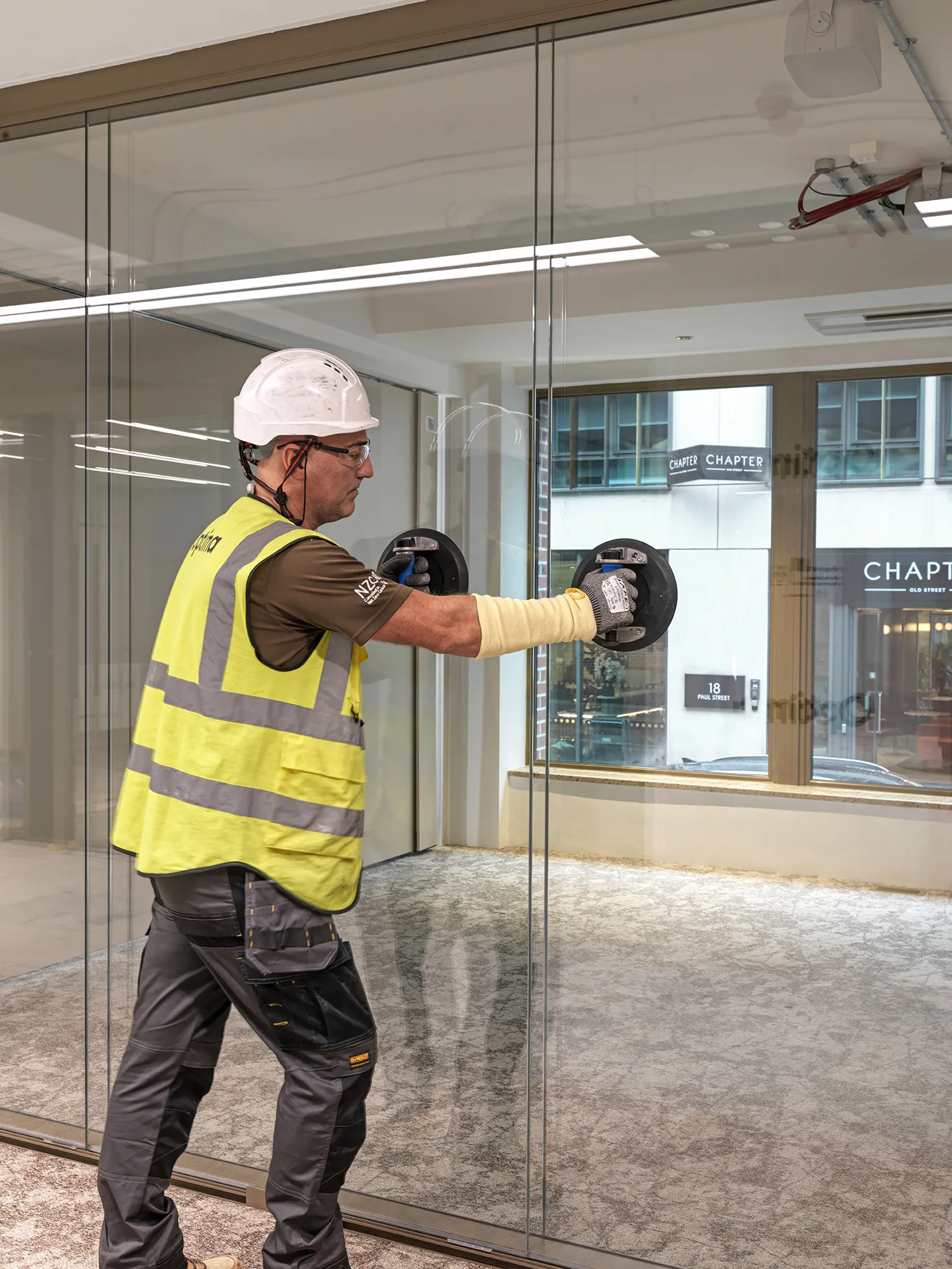
What Is Heat-Soaked Toughened Glass and Why Is It Specified for Glazed Partitions?
Heat soaking helps reduce the risk of spontaneous breakage caused by nickel sulphide inclusions in toughened glass, providing an additional level of assurance for glazed partitioning applications.
Minimising the risk of spontaneous breakage
Toughened safety glass is widely used in glazed partitioning because of its strength and its behaviour when broken. However, like any glass product, it is not completely free from the risk of failure.
One potential cause is the presence of nickel sulphide inclusions within the glass. Although uncommon, these inclusions can lead to spontaneous breakage after the glass has been installed, sometimes without any obvious external cause.
For this reason, Optima recommends heat-soaked toughened glass where toughened glass is specified within our partitioning systems. Heat soaking introduces an additional quality-control process intended to identify panes that may be at greater risk of spontaneous fracture before they reach site.
Why can toughened glass break?
Toughened glass can fail for a number of reasons, including impact, damage to the glass edge, incorrect installation, excessive stresses or imperfections within the glass itself.
Nickel sulphide inclusions are of particular interest because they can cause breakage without an external impact. Nickel sulphide particles can occasionally become trapped within the glass during manufacture. The rapid heating and cooling involved in the toughening process can leave these particles in an unstable state.
Over time, an inclusion can change form and increase slightly in volume. If the resulting stress exceeds the strength of the surrounding glass, the pane can fracture.
This process can happen some time after manufacture or installation, which is why these failures are often described as spontaneous.
What is heat soaking?
Heat soaking is an additional process carried out after glass has been thermally toughened.
The panes are placed within a heat-soak oven and subjected to a controlled heating cycle. The process is designed to accelerate the transformation of certain nickel sulphide inclusions so that glass containing critical inclusions is more likely to fracture during testing rather than after installation.
Glass that completes the heat-soak process successfully can therefore be supplied with a reduced risk of spontaneous breakage associated with nickel sulphide inclusions.
Heat-soaked thermally toughened soda lime silicate safety glass is covered by BS EN 14179, which sets out requirements for the heat-soak process and associated conformity.
Heat soaking reduces risk — it does not remove it entirely
It is important to distinguish between reducing risk and eliminating it.
Heat soaking cannot guarantee that a pane of toughened glass will never break. Breakage can still occur for other reasons, including impact, edge damage, installation conditions or stresses introduced after manufacture.
Its purpose is specifically to reduce the likelihood of spontaneous fracture associated with critical nickel sulphide inclusions.
This distinction is important when specifying glass: heat soaking should form part of the wider consideration of glass type, thickness, dimensions, location, installation and the requirements of the individual project.
Why specify heat-soaked toughened glass?
For glazed partitioning, the consequences of an unexpected glass failure can extend beyond the cost of replacing a pane. There may also be disruption to an occupied workplace and a potential safety risk depending on the location and circumstances of the breakage.
Specifying heat-soaked toughened glass introduces an additional manufacturing control before the glass is installed. For projects where toughened safety glass is required, it provides a practical way of reducing the risk associated with nickel sulphide inclusions while retaining the characteristics required from thermally toughened glass.
For this reason, Optima recommends heat-soaked toughened glass in place of standard toughened glass within relevant partitioning applications.
Recent insights
 Sustainability
Optima contributes to industry debate and guidance on the reuse of glass partitioning
Optima is an active member of the Alliance for Sustainable Building Products (ASBP) and has contributed to the ASBP’s “The Reuse of Glass Partitioning Systems” guidance. We also took part in ASBP’s industry-wide webinar on the subject earlier this year.
View insight Trends
Is AI amplifying design thinking, or replacing it?
With AI impacting all aspects of work in the design community and construction industry, a question on everyone’s lips is what does this mean for me?
View insight Sustainability
Circular Economy in Commercial Construction
Ever thought about the ripple effects your building projects might have on the environment? In the realm of modern construction, there’s an escalating movement towards adopting circular materials, which use sustainable practices deeply rooted in the circular economy.
View insight
Need help with your next project?
Talk to our team for practical advice on systems, performance and specification.
Enquire now
Sign up to the Optima newsletter
Stay up to date with the latest Optima innovations, project news and insights from across the global workplace design community