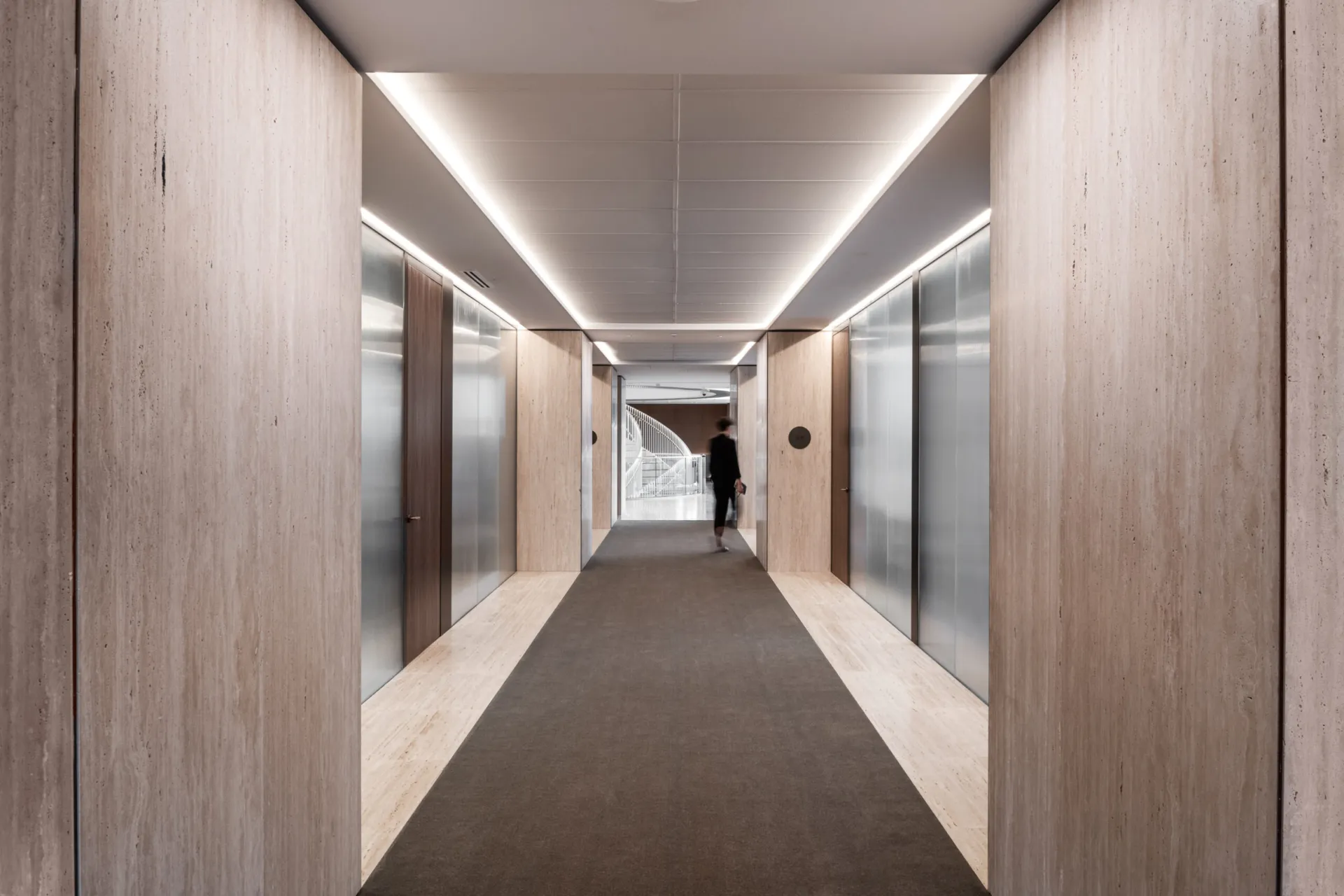
Understanding On-Site Acoustic Testing: How to Measure Real-World Performance
Laboratory testing establishes a controlled measure of acoustic performance, but completed installations can behave differently on site. On-site testing helps verify how a glass partition performs within the finished building.
In the UK, on-site tests are typically conducted in accordance with BS EN ISO 16283. Unlike laboratory tests that isolate a single pane of glass, on-site testing evaluates the “room front” as a whole. This means the result is a composite of the glass, the frame, the door, and the surrounding interfaces.
Standard Benchmarks: BREEAM and BS 8233
The industry often looks to BREEAM (Clause Hea 05) for guidance on indoor acoustic performance. BREEAM references BS 8233:2014, which sets out the acceptable levels of sound insulation between rooms. These levels are measured in Dw, and the required rating is usually determined by three factors:
- The Speech Privacy Level (SPL): How much confidentiality is required?
- Background Noise: The level of sound from mechanical services (NR value).
- Occupancy Type: How the rooms on either side of the partition are being used.
The Three Methods of Measurement
There are several ways to measure sound insulation in the field. Understanding the difference between these metrics is essential for accurate specification and reporting.
1. Dw (Weighted Level Difference)
This is the most straightforward field measurement. It simply calculates the difference in sound levels between the “source” room and the “receiver” room. Because it measures the room as it is, it includes all sound paths (flanking). In a typical office setup, the Dw value can be up to 8dB lower than the laboratory Rw value of the glass itself.
2. DₙT,w (Weighted Standardised Level Difference)
Similar to Dw, this method measures the level difference including flanking paths, but it adds a correction for the “reverberation time” or absorption within the receiving room. By standardising the result against the room’s furniture and finishes, it provides a more consistent comparison. Typically, you should expect this result to be at least 5dB lower than the lab-tested Rw value.
3. R’w (Weighted Apparent Sound Reduction Index)
The Rw is a field measurement that follows the same logic as the laboratory Rw but accounts for the “apparent” reduction, including flanking. This method is rarely used for standard office partitions; it is generally reserved for testing walls with very large surface areas.
Why On-Site Results Differ from the Lab
It is a common misconception that a partition with a 40dB laboratory rating will deliver 40dB on-site. In reality, all elements of a room’s construction, not just the glass, must work in tandem.
When we move from the controlled environment of a lab to a live construction site, we are no longer testing a product in isolation; we are testing an assembly. Any single under-performing element in that assembly, from the ceiling to the floor, will cause the composite result to drop.
Verified on-site testing ensures that the client receives the level of privacy they actually paid for, rather than just a theoretical figure on a certificate.
Recent insights
 Sustainability
Optima contributes to industry debate and guidance on the reuse of glass partitioning
Optima is an active member of the Alliance for Sustainable Building Products (ASBP) and has contributed to the ASBP’s “The Reuse of Glass Partitioning Systems” guidance. We also took part in ASBP’s industry-wide webinar on the subject earlier this year.
View insight Trends
Is AI amplifying design thinking, or replacing it?
With AI impacting all aspects of work in the design community and construction industry, a question on everyone’s lips is what does this mean for me?
View insight Sustainability
Circular Economy in Commercial Construction
Ever thought about the ripple effects your building projects might have on the environment? In the realm of modern construction, there’s an escalating movement towards adopting circular materials, which use sustainable practices deeply rooted in the circular economy.
View insight
Need help with your next project?
Talk to our team for practical advice on systems, performance and specification.
Enquire now
Sign up to the Optima newsletter
Stay up to date with the latest Optima innovations, project news and insights from across the global workplace design community